
Leading with Feedback:
Empowering Performance Conversations
Overview
This is a concept project that helps managers improve their feedback with employees during observations, reviews, and impromptu situations by avoiding common pitfalls.
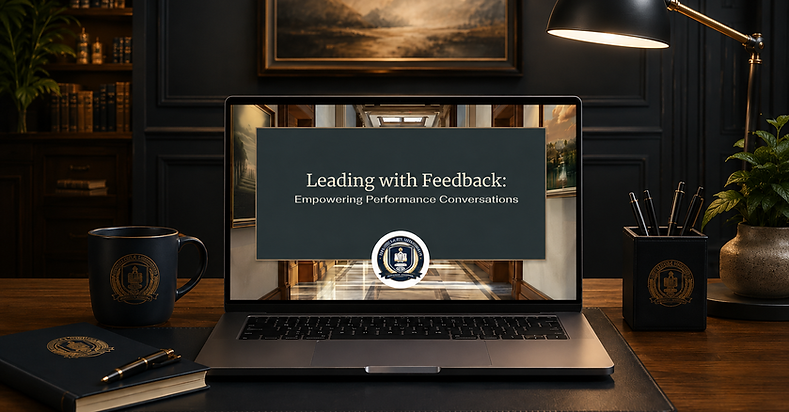
Project Title Screen: identifies the course the learner will take
Audience: managers, supervisors, and other leaders who provide guidance and feedback to employees.
Responsibilities: research, instructional design, eLearning development, action mapping, text-based storyboard, style guide, mood board, wireframing, high-fidelity mockups, and interactive prototype.
Tools Used: Articulate Storyline 360, Figma, ChatGPT, Freepik (Magnific), OpenArt, Dzine, and Miro
The Problem
Whitelocke University, a fictional university, is experiencing a high turnover rate. According to employee exit interviews, many employees reported feeling dismissed, undervalued, and disrespected during interactions with their supervisors. This indicated a need for managers to improve how they communicate and deliver feedback. The university as a result is facing increased hiring and training costs, productivity losses, and decreased employee morale.
The Solution
There are three different solutions to this problem:
-
Scenario-based eLearning course
-
Instructor-led training with role-playing activities
-
Mentoring and on-the-job practice
The best solution is the e-learning course because of the large employee base, differing time zones with remote managers, efficient onboarding, and cost. It also provides a safe learning environment before the managers are needed to apply the soft skills on the job.

Sample Decision Point for Learner: Shows highly nuanced soft skill learning
My Process
I developed this project using the ADDIE model (Analyze, Design, Develop, Implement, and Evaluate).
Analysis: researched the problem, created an action map to identify key actions
Design: created storyboard, visual mockups
Development: developed an interactive prototype, and final eLearning experience
Implementation: hosted on AWS and uploaded it onto an LMS
Evaluate: gathered peer feedback, assessed for improvement, reflected for takeaways and future improvements
Action Map
I researched common reasons employees leave their jobs and reviewed best practices in workplace communication and feedback. Using these findings, I created an action map to identify the key actions managers need to demonstrate during employee observations, reviews, and impromptu meetings. Three high-priority actions emerged from this process, helping focus the project on improving communication, morale, and productivity through behavior change.

Action Map: Identifies key actions for improved job performance
Visual Storyboard
I created a visual storyboard as the blueprint for the project based on Gagne’s Nine Events of Instruction. To gain attention, the experience opens on the university campus and invites learners to enter the building, immediately signaling that they will actively participate in the learning experience rather than passively consume information.
The images reinforce the context of each scenario, while realistic employee characters help create authentic workplace interactions. Learners experience the consequences of their decisions before retrying scenarios, encouraging reflection and reinforcing effective feedback strategies in a low-risk environment.
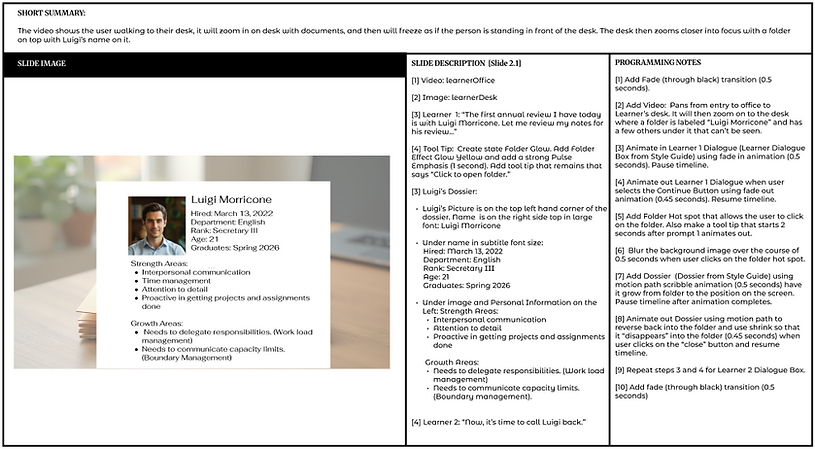
Represents Main Storyboard: Shows how the visuals aided each step for both the slide description and programming notes.
To support decision-making, learners are provided with two job aids. The first is an employee dossier containing workplace information a manager would naturally have before a conversation. The second is a guiding question that prompts learners to identify the most appropriate response for each situation.
Visual Mockups
I used the storyboard as the foundation for my visual design process, helping to reduce the number of iterations needed to finalize the layout and style guide.
While storyboarding, I also created a mood board to establish the project's visual direction and guide image selection.
Together, these deliverables informed the final style guide, wireframes, and high-fidelity mockups that were used to create the interactive prototype.
Since the project was set at a fictional university, I wanted the design to feel intentionally connected to that environment. The dark academia color palette, typography, imagery, and layout reinforced the atmosphere of an established university campus, helping to create a more immersive and authentic learning experience.

Style Guide: Keeps uniformity throughout the whole project.

Visual Mock Ups: Demonstrates consistent application of the style guide across the project.
Interactive Prototype
I created an interactive prototype in Articulate Storyline 360 that included the first scenario, since its layouts and interactions were reused throughout the project.
The prototype allowed me to gather feedback on the speech and thought bubble colors, their compatibility with the video imagery, and the effectiveness of the animations before full development.
Full Development
After gathering feedback from the interactive prototype, I developed the full project in Articulate Storyline 360. I used AI-generated videos throughout the experience and applied video editing techniques to create smooth, realistic interactions.
During final development, I added closed captions to improve accessibility and support to a wider range of learners.
To reinforce learning beyond the course, I created a downloadable handout containing additional guidance for the three meeting types featured in the scenarios. I also developed an automated certificate of completion that generates the learner's name upon course completion, supporting both organizational record-keeping and learner documentation.

Printable Handout: Reinforces learning beyond the course.

Printable Certificate: Provides proof of completion for organizational records
Results and Takeaways
Since this was a concept project, the next step would be to gather feedback from managers and make improvements based on their experiences.
During development, I collected peer feedback, and two themes emerged consistently: reviewers appreciated the authenticity of the AI-generated characters and the consistent visual design across the scenarios. They also responded positively to the downloadable handout and automated completion certificate.
One of my biggest takeaways was learning how to effectively integrate AI tools into the development process while maintaining consistency and realism. I also gained experience designing authentic scenario-based interactions, creating cohesive visual experiences, and selecting the appropriate tools to support different types of learner interactions.